
- On a recent evening in Seoul, something unusual happened — not in scale, but in consequence.

When BTS returned to the stage at Gwanghwamun, the event was widely described as a concert. It was not. It was, more precisely, a convergence of emotion on a civic scale — a moment in which music, memory, and identity briefly aligned across hundreds of thousands of individuals.
Such moments are not new in the age of global fandom. What is new is what follows them.
The prevailing assumption in tourism has long been that intensity begets intensity — that after a spectacle, people seek more spectacle. Larger cities, brighter lights, deeper consumption. But recent patterns suggest a quiet reversal. Increasingly, what follows emotional saturation is not escalation, but withdrawal.
The question, then, is not simply where people go after an event like this. It is what they are seeking when they leave.
From Spectacle to Stillness
Travel, in its conventional framing, has been an extension of desire — a way of accumulating experiences, images, and proximity to the extraordinary. Yet the contemporary traveler appears to be motivated by a different impulse: not to acquire, but to process.
Emotional experiences of the magnitude produced by BTS do not dissipate easily. They linger, unsettled, demanding interpretation. And interpretation, unlike consumption, requires space.
This is where the geography of travel begins to shift.
In the eastern reaches of South Korea, along the coastline of Gangwon Province, lies Mukho — a modest port town, largely absent from the traditional circuits of international tourism. It offers none of the markers typically associated with post-event travel. There are no grand attractions, no curated spectacles, no promise of amplification.
What it offers instead is restraint.
The Function of Silence
In Mukho, the dominant presence is not architecture or activity, but rhythm — the repetition of waves, the gradual arrival of light, the absence of interruption. It is, in a sense, an anti-event.
And it is precisely this absence that has begun to define its relevance.
If the modern cultural event is characterized by compression — of time, of attention, of affect — then places like Mukho represent the inverse: expansion. They allow for duration, for reflection, for the slow reorganization of feeling into meaning.
This suggests a broader transformation in how we understand travel.
The movement is no longer from one site of stimulation to another, but from stimulation to resolution.
A New Pattern Emerges
What is taking shape can be described, simply, as a three-stage sequence:
Event → Emotion → Recovery
Seoul provides the event.
BTS delivers the emotional intensity.
And locations like Mukho offer the conditions for recovery.
This is not merely a behavioral trend; it is a structural shift. It repositions peripheral regions — long defined by their distance from cultural centers — as essential complements to them. It also reframes tourism not as an industry of attraction, but as an infrastructure of care.
Beyond Tourism
To view this shift solely through the lens of travel would be to miss its broader implications.
What we are witnessing is the emergence of what might be called emotional aftercare — a recognition that experiences of high intensity require environments of equal intentionality in their aftermath.
In this context, Gangwon Province is not simply a destination. It becomes a counterpoint — a necessary second movement in a larger cultural composition.
Mukho, in particular, stands not as an endpoint, but as a beginning. A place where the noise of the event recedes, and something quieter, more durable, can take its place.
The Question That Remains
In the end, the most revealing aspect of a cultural moment is not how it peaks, but how it resolves.
If cities like Seoul are designed to gather and amplify, then places like Mukho are designed — perhaps unintentionally — to absorb and settle.
The question for travelers is no longer where the next spectacle will be found.
It is where, after everything has been felt, one goes to understand it.
BEST 뉴스
-

[지형덕칼럼] 동해 AI데이터센터, 규모보다 수요와 효율을 증명해야 한다
AI 연산 효율을 높이는 기술 등장…동해시와 GS는 단계별 수요·전력 사용·지역 혜택을 함께 설명해야 한다 Emerging technologies aim to improve AI computing efficiency. Donghae and GS should explain phased demand, power requirements and tangible local benefits. AI데이터센터의 경쟁력을 설명할 때... -

[지형덕칼럼] 동해시장, AI데이터센터의 ‘규모’보다 ‘실익’을 증명하라
GS의 냉각기술 개발과 도의회의 상생 요구가 던지는 질문…전력·물·고용·지역기업 참여를 검증 가능한 계획으로 제시해야 한다 GS’s cooling technology initiative and provincial calls for community benefits demand verifiable plans for power, water, employment and local business participation. 동... -

동해 AI데이터센터, 전기는 어디서 오나…화력발전 연계 계획 설명 필요
동해 AI데이터센터 캠퍼스의 전력공급과 관련해 화력발전소 연계 계획의 구체적인 내용과 지역 환경에 미칠 영향을 설명할 필요가 제기된다. 대규모 전력 확보 여부와 함께 어떤 발전원에서 전기를 조달하고, 기존 발전소 운영에 어떤 변화가 생기는지 시민이 확인할 수 있어야 한다는 취... -

[기자의눈]동해 AI데이터센터, 시민의 알권리에서 상생을 시작하자
전력·물·생활환경과 지역 일자리에 대한 충분한 설명이 신뢰의 출발점…동해시와 GS가 사업 초기부터 공개하고 소통하는 체계를 마련해야 Clear information on power, water, living conditions and local jobs is essential to trust. Donghae and GS should establish transparent communication from the outs... -

동해 AI데이터센터, 주민의 ‘열섬·농작물 피해’ 우려에 자료로 답해야
시사K뉴스|지형덕 기자 동해 AI데이터센터 주변 주민들이 걱정하는 문제 가운데 하나는 열이다. 기존 산업시설이 들어선 지역에 대규모 데이터센터까지 가동되면 여름철 생활환경과 인근 농작물에 부담이 더해지는 것 아니냐는 우려다. 주민설명회에서는 인근 포도농원의 피해를 호소하며 데이터센터 조성 이후 ... -

[지형덕칼럼] 강릉 AIDC 논란의 교훈…동해시장, 상생에도 ‘패스트트랙’을 적용하라
지형덕|시사K뉴스 강릉 AI데이터센터 유치를 둘러싼 정치 공방이 거세지고 있다. 그러나 시민이 확인해야 할 핵심은 정당 간 비난의 강도보다 사업의 실제 준비 수준이다. 무엇이 확정됐고 무엇이 협의 중인지, 전력과 부지 등 필수 조건은 어느 단계까지 확보됐는지부터 분명히 해야 한다. 국민의힘 강원지역 국...
전체댓글 0
실시간뉴스


추천뉴스

포토뉴스
more +-
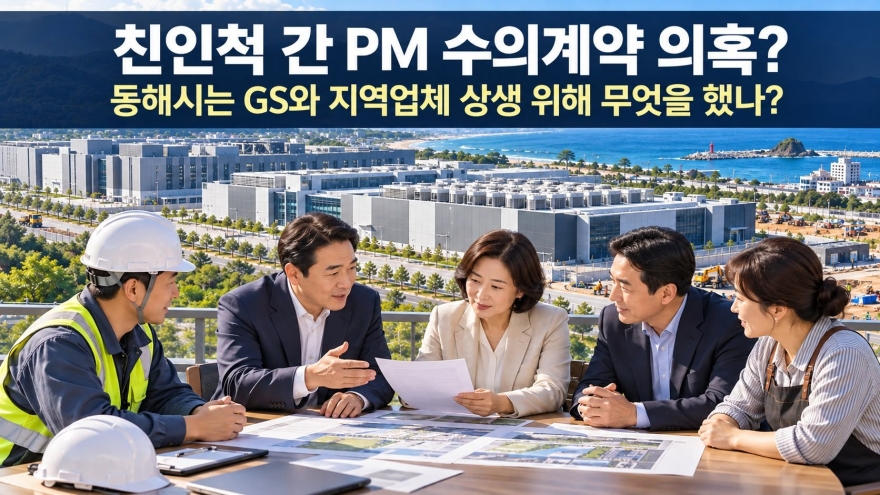
동해 AIDC 지역상생, 특정 업체 추천보다 ‘만남의 장’이 먼저다
요약 | 동해 AI 데이터센터 사업과 관련해 지역업체들이 원하는 것은 특정 업체의 수주 보장이 아니다. 시장이 GS와 지역의 자격 있는 업체 사이에 만남과 정보 공유의 기회를 마련해, 공정한 참여 가능성을 찾도록 돕는 일이다. 관련 계약이 이미 마무리됐다는 제보가 나온 가운데, 착공을 앞두고 동해시는 법정 제... -
동해시 묵호동·시흥시 배곧1동, 주민자치 교류 ‘맞손’
동해시 묵호동이 시흥시 배곧1동 주민자치회와 주민자치 교류 활성화를 위한 자매결연 협약을 체결했다. 사진/묵호동제공 최근 묵호동 행정복지센터에서 열린 협약식에는 양 지역 주민자치 조직과 동장 등 관계자 30여 명이 참석해 뜻깊은 자리를 가졌다. 이번 협약을 통해 양 단체는 ▲지역 대표 축... -
동해시, 2027년 제21기 청소년참여위원회 신규 위원 모집
동해시는 오는 11월 4일부터 20일까지 ‘2027년 제21기 동해시청소년참여위원회’에서 활동할 신규 위원을 모집한다. 「청소년 기본법」에 근거해 운영되는 청소년참여위원회는 청소년들이 지역 정책 수립과 의사결정 과정에 주도적으로 참여해 다양한 의견을 제안하고 자문하는 청소년 참여기구다. 특히 2027년에는 ... -
동해시, 고병원성 AI 등 가축전염병 차단 ‘생석회’ 지원 11월 10일까지 신청 접수
동해시가 겨울철 고병원성 조류인플루엔자(AI) 등 가축전염병 유입을 선제적으로 차단하기 위해 ‘방역용 생석회 지원 사업’을 추진하고, 오는 11월 10일까지 신청을 받는다. 최근 주변국에서 고병원성 AI 항원이 검출되고 겨울철새가 도래함에 따라 국내 발생 위험이 커짐에 따라, 시는 축산농가의 철저한 차단 방역을...